Sunscreen for Men: Why It Matters and Best Picks in Australia
Sunscreen for Men: Why It Matters and Best Picks in Australia
Let’s be blunt: sunscreen for men in Australia isn’t a grooming nicety — it’s the single most important thing you can put on your skin, full stop. Australia has the highest skin cancer rates in the world, our UV levels are extreme even on cloudy days, and the vast majority of visible skin ageing — wrinkles, spots, leathery texture — comes from sun exposure, not birthdays.
Yet most blokes still treat sunscreen as something for the beach. This guide to sunscreen for men Australia-wide makes the case for daily SPF, explains what to actually buy (because the wrong sunscreen is the one you won’t wear), and covers the practical realities: reapplication, sweaty jobs, bald heads, and the excuses that need retiring.
Why Australian men specifically need this lecture
The numbers are sobering. Around two in three Australians will be diagnosed with skin cancer by the age of 70, according to the Cancer Council — and men are diagnosed at higher rates than women, partly because we spend more time outdoors and partly because we’re worse at sun protection. Outdoor workers — tradies, farmers, lifeguards, couriers — cop many times the UV dose of office workers.
Then there’s the ageing angle. Dermatologists estimate that the majority of premature skin ageing is photoageing — damage from UV, not time. The deep forehead lines, the mottled pigmentation, the rough texture men chalk up to “getting older” is largely sun damage accumulated over decades. Every day of unprotected exposure adds to a tab your skin presents in your forties and fifties.
The good news: it’s remarkably preventable. Daily sunscreen use is one of the best-evidenced interventions in all of dermatology — it measurably reduces skin cancer risk and visibly slows ageing. No other skincare product comes close to this return on effort. Our men’s skincare routine guide puts it as step three for exactly this reason.
SPF, broad spectrum, water resistant: what the label means
SPF (Sun Protection Factor) measures protection against UVB — the burning rays. SPF 50 blocks about 98% of UVB; SPF 30 about 97%. The difference looks small, but in Australian conditions it matters, especially since everyone under-applies. In Australia, go SPF 50+ as standard — it’s the consistent recommendation from the Cancer Council and dermatologists here.
Broad spectrum means it also protects against UVA — the ageing rays that penetrate deeper, come through glass, and are present all day year-round. Always choose broad spectrum. Every reputable Australian sunscreen is, but check.
Water resistant means it holds up to sweat and water for the tested period (usually 4 hours in Australia’s testing). It does not mean waterproof — nothing is. If you’re sweating heavily or swimming, reapply after towelling off regardless.
TGA regulation: sunscreens in Australia are regulated as therapeutic goods by the Therapeutic Goods Administration, which means SPF claims are tested to a standard — stricter than in many countries. An SPF 50+ label here means something. This is one category where “Australian made for Australian conditions” isn’t just marketing.
Choosing a sunscreen for men you’ll actually wear
The best sunscreen for men Australia has on shelves is the one you use daily, so wearability beats everything. Common complaints and fixes:
“It feels greasy.” Modern gel and fluid formulas have solved this. Look for “dry-touch”, “matte” or “gel” on the label. Cancer Council Face Day Wear Matte SPF 50, Hamilton Everyday Face SPF 50, and Neutrogena Ultra Sheer are all designed to disappear on skin. Korean and Japanese sunscreens (available at Lila Beauty, Stylevana AU and some pharmacies) are famous for elegant, lightweight textures — the famous “no white cast, no grease” formulas.
“It leaves a white cast.” Mineral (zinc-based) sunscreens can look chalky, especially on deeper skin tones. Chemical (organic filter) sunscreens generally apply clear. If you prefer mineral for sensitivity reasons, look for “tinted” versions or micronised formulas. Most men do best with a chemical or hybrid formula for daily face use.
“It stings my eyes.” Sweat carrying sunscreen into eyes is miserable. Use a stick sunscreen around the eye area, or choose formulas labelled for sensitive skin. Wearing sunglasses (which you should anyway) helps physically block the migration.
“It pills under my moisturiser.” Let moisturiser absorb for a minute before applying sunscreen, and don’t rub excessively — press and smooth. Silicone-heavy moisturisers under silicone-heavy sunscreens pill most; if it’s a persistent problem, switch to a moisturising sunscreen and skip the separate moisturiser.
“I hate the smell.” Fragrance-free options abound now — QV, Hamilton Sensitive, La Roche-Posay Anthelios fragrance-free versions. The classic “sunscreen smell” is optional in 2026.
How much, how often, and the reapplication reality
How much: the tested dose is 2mg per square centimetre of skin — in practical terms, about a teaspoon (5ml) for face and neck, and a shot glass (35ml) for full body in swimwear. Almost nobody applies this much. Be generous: most men use a quarter of what they should, which dramatically reduces the real-world SPF.
When: every morning as the last step of your routine, 20 minutes before sun exposure if you want to be precise (modern formulas work faster, but the habit of applying before leaving the house is what matters). Every day — UV penetrates cloud, and UVA comes through office windows.
Reapplication: every two hours when outdoors, and after swimming, heavy sweating or towelling. This is the advice everyone ignores. Realistic guidance: if you work outdoors, reapply at smoko and lunch — keep a tube where you’ll see it. Tradies: the ute dashboard (though heat degrades sunscreen — the esky or toolbox is better), the site shed, your lunch bag. Office workers who applied properly in the morning are well covered for incidental exposure; reapply if you’re eating lunch outdoors.
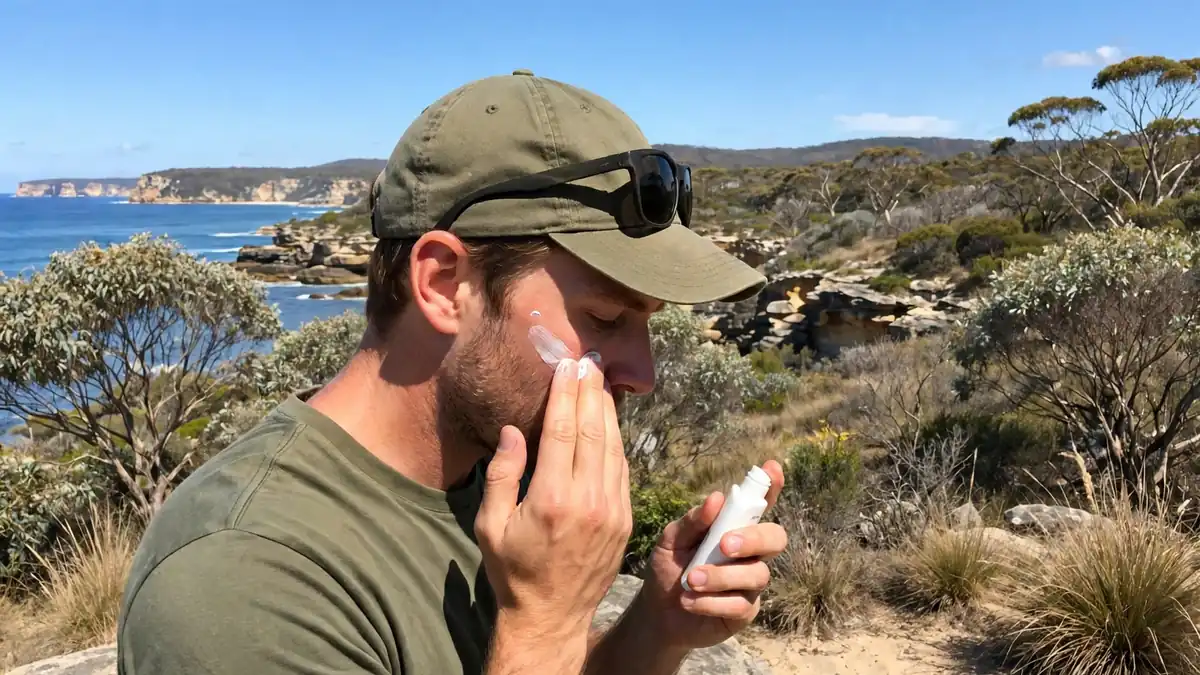
Don’t forget: ears (a top skin cancer site in men), back of the neck, scalp (if thinning or shaved — see our haircut guide’s sun note), lips (SPF lip balm exists — use it), and hands (they age visibly and drive all day in sun).
Best face sunscreen for men Australia (2026)
These are well-regarded, widely available options suited to daily facial use — each one a sunscreen for men Australia shoppers can buy at any pharmacy or supermarket. All are SPF 50+, broad spectrum — non-negotiable in this guide:
- Cancer Council Face Day Wear Moisturiser Matte SPF 50: made for Australian conditions by the organisation that knows our sun best. Matte finish, doubles as moisturiser, available at every pharmacy and supermarket. The default recommendation.
- Hamilton Everyday Face SPF 50+: Australian-made, lightweight, no white cast, very affordable. A tradie-bag staple.
- Neutrogena Ultra Sheer Face SPF 50: the “dry-touch” formula lives up to the name. Good for oily skin, widely stocked.
- La Roche-Posay Anthelios UVMune 400 SPF 50+: the premium pick — superb filters, elegant texture, excellent for sensitive skin. Pricier, available at Priceline and Chemist Warehouse.
- Natio Daily Defence Face Moisturiser SPF 50+: Australian brand, pleasant to wear, good everyday option.
- QV Face Moisturising Day Cream SPF 30: note the SPF 30 — fine as a moisturiser for low-exposure days, but layer proper SPF 50 over it if you’re outdoors. Included because sensitive-skinned men love the base formula.
For body and outdoor work: Cancer Council Work Zinc and Hamilton Sport SPF 50+ are built for sweaty conditions. Zinc sticks are brilliant for noses, ears and lips during sport — surf lifesavers have known this forever.
Where to buy: Chemist Warehouse, Priceline, Woolworths and Coles all stock the main options. Buy the one you’ll wear — the budget tube applied daily beats the premium tube sitting in the drawer.
Sunscreen myths that need to die
“I don’t burn, so I don’t need it.” Burning is UVB. The UVA damage — ageing, DNA damage, cancer risk — happens without any burn at all. “I tan easily” is not protection; a tan is literally visible DNA damage.
“My moisturiser has SPF 15, that’s enough.” It’s not, for Australia — and you’re almost certainly applying a quarter of the amount needed for even that SPF 15 to work. SPF 15 moisturiser is better than nothing the way a bicycle helmet is better than nothing in a car crash. Get SPF 50.
“Sunscreen causes vitamin D deficiency.” Studies consistently show daily sunscreen users maintain adequate vitamin D — Australians get plenty of incidental exposure, and the Cancer Council’s position is that normal daily activities provide sufficient vitamin D for most people. If you’re concerned, a blood test and your GP settle it — don’t skip sunscreen on a hunch.
“It’s cloudy, I don’t need it.” Up to 80% of UV penetrates cloud. Some of the worst burns happen on overcast days because people drop their guard. Check the UV index, not the clouds.
“Dark skin doesn’t need sunscreen.” Lower risk is not no risk — and skin cancers in darker skin are often diagnosed later, with worse outcomes. Everyone in Australia needs sun protection.
The full sun protection picture
Sunscreen for men Australia-wide is one of five measures, not the whole strategy. The Cancer Council’s Slip, Slop, Slap, Seek, Slide still stands:
- Slip on protective clothing — a rashie for swimming, long sleeves for outdoor work where practical.
- Slop on SPF 50+ sunscreen — the subject of this guide.
- Slap on a hat — broad-brimmed, not a cap (caps leave ears and neck exposed — the exact spots men get cancers).
- Seek shade — especially 10am to 3pm when UV peaks.
- Slide on sunglasses — close-fitting, wraparound styles that meet the Australian standard.
Check the UV index on the BOM website or your weather app — when it’s 3 or above, protection is needed. In most of Australia, that’s most of the year. Make it automatic: sunscreen with teeth-brushing, hat by the door, sunglasses in the car.
And get your skin checked. Annual skin checks are one of the highest-value health habits Australian men can adopt — our guide to skin cancer checks explains what to expect and when to go. Sunscreen prevents; checks catch. You want both.
FAQs
Is SPF 50 really necessary, or is SPF 30 enough?
In Australia, SPF 50+ is the standard recommendation from the Cancer Council and dermatologists. The theoretical difference between SPF 30 (97% UVB blocked) and SPF 50 (98%) looks tiny, but real-world application is always thinner than lab testing — starting from SPF 50 gives you a bigger safety margin for imperfect application. Given our extreme UV, SPF 50+ is the sensible default for daily use.
Can I use body sunscreen on my face?
You can — the protection is the same. The difference is cosmetic: face formulas are designed to feel lighter, pill less, and sit better under daily wear. If the choice is between body sunscreen on your face and no sunscreen, use the body sunscreen. But a dedicated face formula is more pleasant daily, which means you’ll actually use it — and that’s what matters.
Does sunscreen expire?
Yes. Check the expiry date — expired sunscreen may not provide the labelled protection. Heat accelerates degradation, so that tube that’s lived on your car dashboard for two summers is suspect even before expiry. Store sunscreen cool where practical, replace annually, and never rely on last year’s half-used bottle for a beach day.
What about sunscreen for bald heads?
Essential. Scalps are a common skin cancer site precisely because people forget them. Use a non-greasy face sunscreen, a scalp-specific SPF, or simply wear a hat — a broad-brimmed hat is arguably the best scalp protection going. Reapply if sweating. A burnt scalp is uniquely miserable and entirely preventable.
Is expensive sunscreen better than cheap sunscreen?
For protection, no — SPF 50+ is SPF 50+ under Australia’s TGA testing standards regardless of price. What money buys is wearability: nicer texture, less white cast, better water resistance, more pleasant scent. The budget Hamilton and the premium La Roche-Posay both protect; pick the one you’ll actually apply generously every day. Compliance beats formulation.
General health information only — not medical advice. For sun protection guidance see the Cancer Council at cancer.org.au. If you notice new or changing spots on your skin, see your GP promptly — early detection saves lives.