Skin Cancer Checks Australia: What Men Need to Know
Skin cancer checks Australia men: what you need to know
Australia has the highest skin cancer rates in the world, and men bear a disproportionate share of it. A regular skin cancer check in Australia for men is one of the simplest, highest-value health habits you can adopt: a 15-minute appointment that catches potentially deadly cancers while they’re still easily treatable. Yet blokes are the least likely to book one.
This guide to skin cancer checks Australia men covers what actually happens at a skin check (no surprises), how often you need one, how to check your own skin between visits, and what to do the moment you spot something changing. It’s general information — not a substitute for professional advice — but it might be the nudge that gets you booked in.
Important: this article is general information only, not medical advice. If you notice a new or changing spot, see your GP or a skin clinic promptly — don’t wait for your next scheduled check.
Why men are at particular risk
The statistics are stark. Around two in three Australians will be diagnosed with skin cancer by age 70, according to the Cancer Council, and men are diagnosed with melanoma — the most dangerous form — at significantly higher rates than women, with worse outcomes. Several factors stack against blokes:
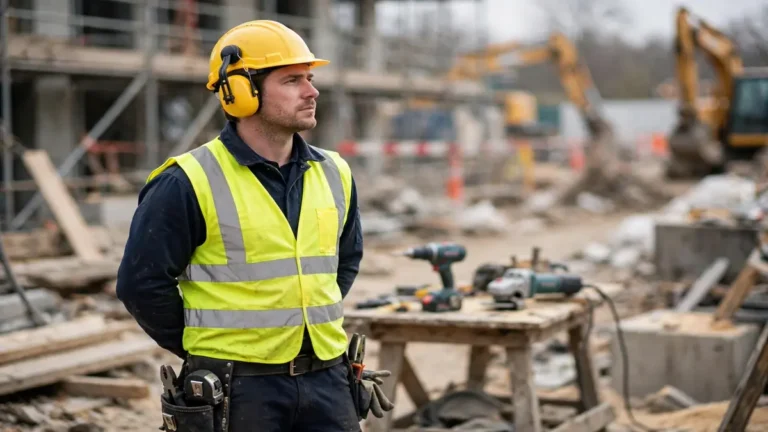
- More UV exposure: men are overrepresented in outdoor work (construction, farming, trades) and outdoor recreation (surfing, fishing, golf, footy). Cumulative UV dose is the primary driver of skin cancer.
- Worse sun protection: men are less likely to use sunscreen regularly, wear protective clothing, or seek shade. The “she’ll be right” approach to sun has a body count.
- Later presentation: men delay getting spots checked. With melanoma, delay is measured in outcomes — early melanomas are highly curable; late ones are not.
- Missed spots: men get melanomas on the back, scalp and ears — places they can’t easily see — more often than women. A partner’s eyes or a professional check catches what the mirror misses.
The counterpoint is encouraging: skin cancer is one of the most preventable cancers (sun protection works) and one of the most curable when caught early (five-year survival for early melanoma is extremely high). Checks are the bridge between those two facts.
The three main types (what you’re checking for)
Basal cell carcinoma (BCC): the most common skin cancer. Usually appears as a pearly lump, a sore that won’t heal, or a slightly scaly patch — often on sun-exposed areas like the face, ears, neck and hands. Slow-growing and rarely spreads, but needs treatment — it invades locally and causes real damage if ignored for years.
Squamous cell carcinoma (SCC): the second most common. Often a thickened, scaly or crusty spot, sometimes tender. Also favours sun-exposed areas. Can spread if neglected, but very treatable when caught early.
Melanoma: less common but the most dangerous — responsible for the majority of skin cancer deaths. Can develop in an existing mole or appear as a new dark spot anywhere on the body, including places that rarely see sun (soles of feet, under nails, scalp). Early detection is everything: thin, early melanomas are usually cured with simple excision; thick or spread melanomas are a different story entirely.
You don’t need to diagnose these yourself — that’s the clinician’s job. You need to notice change and get it checked. That distinction matters: your role is surveillance, not diagnosis.
What happens at a professional skin check
Knowing what to expect from skin cancer checks Australia men attend removes the main barrier for most men. Here’s the typical process at a GP skin check or dedicated skin clinic:
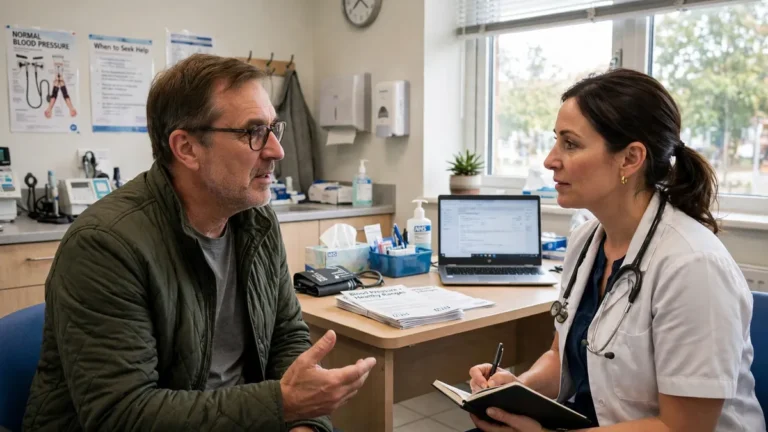
- History: questions about your sun exposure, outdoor work, sunburn history, family history of skin cancer, and any spots you’re concerned about. Mention specific spots upfront — point them out.
- Full-body examination: you’ll undress to your underwear (gowns are provided) while the doctor systematically examines your skin head to toe — scalp, ears, face, neck, torso, arms, hands, legs, feet, and yes, areas you’d rather they didn’t. It’s clinical, quick and professional.
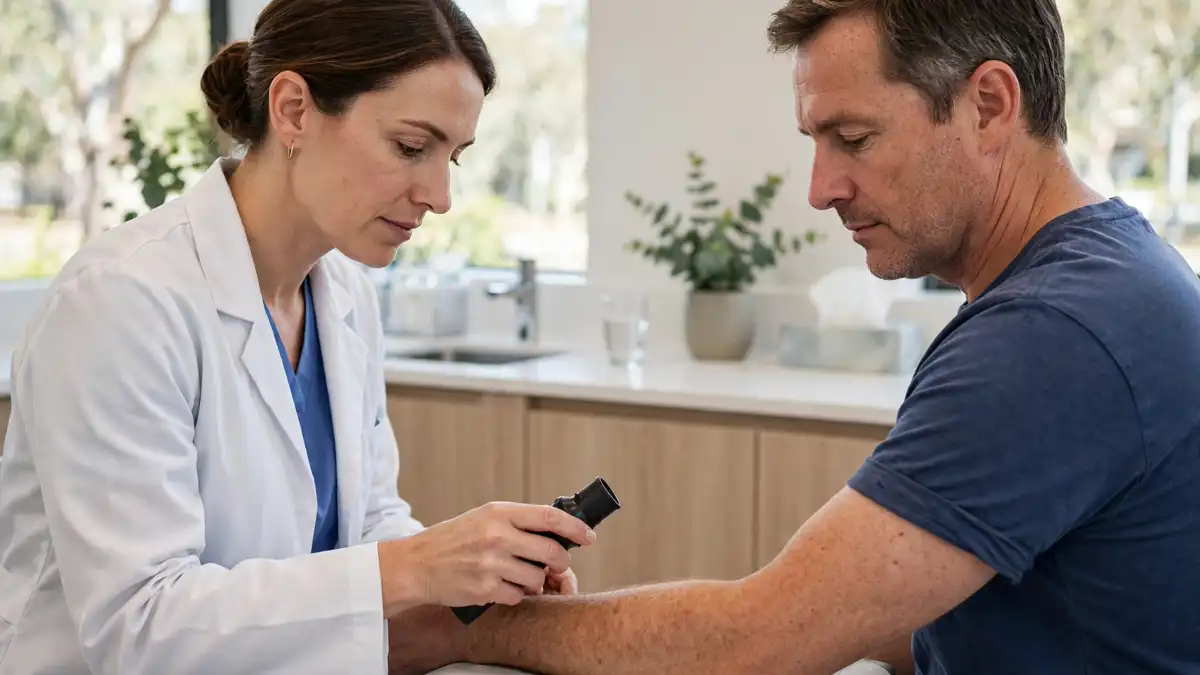
- Dermatoscope: for any spot of interest, the doctor uses a dermatoscope — a handheld magnifier with polarised light that reveals structures invisible to the naked eye. Painless, takes seconds per spot.
- Photography/mapping (some clinics): total-body photography creates a baseline for tracking changes over time, particularly useful if you have many moles. Not every clinic offers it; ask if you’re high-risk.
- Biopsy if needed: if a spot looks suspicious, the doctor may take a small sample (punch or shave biopsy) under local anaesthetic, or excise the whole spot. It’s quick, nearly painless, and the sample goes to pathology for definitive diagnosis. This is not bad news — it’s thoroughness.
- Plan: you’ll be told what was found, what (if anything) needs follow-up, and when to return — typically annually, or sooner for high-risk patients.
Total time: 15–30 minutes. Cost: varies — many GPs bulk bill skin checks, dedicated skin clinics often charge privately (ask when booking). Either way, it’s among the cheapest potentially life-saving appointments in medicine.
Skin cancer checks Australia men: how often to book
There’s no single mandated schedule — it depends on your risk. General guidance used by Australian clinicians:
- High risk (annual checks): fair skin that burns easily, history of blistering sunburns (especially in childhood), outdoor workers, previous skin cancers, many moles (50+), atypical moles, family history of melanoma, or immune suppression. If several of these apply, annual professional checks are the standard advice.
- Moderate risk (every 1–2 years): some risk factors but no personal history — discuss frequency with your GP.
- Lower risk: regular self-checks plus prompt GP visits for anything concerning. Your GP can advise whether scheduled professional checks are warranted.
When in doubt, get one check and let the clinician set your interval based on what they find. One appointment establishes your baseline and your schedule. Our guide to health checks after 40 puts skin checks in the broader preventive picture.
Self-checks: your job between appointments
Professional skin cancer checks Australia men attend are periodic; your eyes are always available. Check your skin every few months — it takes ten minutes:
How: in a well-lit room with a full-length mirror and a hand mirror for hard-to-see areas. Systematically cover: face (including nose, lips, ears — use the hand mirror behind ears), scalp (part hair or ask someone to look), neck, shoulders, chest, underarms, arms, hands (including between fingers and under nails), torso front and back (hand mirror), buttocks, legs, feet (including soles and between toes).
What to look for — the ABCDE of melanoma:
- A — Asymmetry: one half unlike the other.
- B — Border: irregular, blurred or jagged edges.
- C — Colour: varied colours or shades within one spot — tan, brown, black, red, white, blue.
- D — Diameter: larger than 6mm (pencil eraser size) — though melanomas can be smaller.
- E — Evolving: any change in size, shape, colour, elevation, or new symptoms like itching, crusting or bleeding. Evolution is the most important sign.
For non-melanoma cancers, watch for: sores that don’t heal within a few weeks, new scaly or crusty patches, pearly lumps, or any spot that’s growing, bleeding or persistently itchy.
The “ugly duckling” rule: the spot that looks different from all your other moles deserves attention, even if it doesn’t tick ABCDE boxes. You know your skin’s patterns — trust the outlier instinct and get it checked.
Photograph suspects: a phone photo with a coin for scale, dated, gives you and your doctor an objective record of change. Far more reliable than memory.
Sun protection: preventing what checks detect
Checks catch cancer; sun protection prevents it. Both matter. The Cancer Council’s Slip, Slop, Slap, Seek, Slide remains the framework:
- Slip on sun-protective clothing — long sleeves for outdoor work, rashies for water.
- Slop on SPF 50+ broad-spectrum sunscreen — daily on exposed skin, reapplied when outdoors. Our sunscreen guide for men covers choosing one you’ll actually wear.
- Slap on a broad-brimmed hat — caps leave ears and neck exposed, and those are prime melanoma sites in men.
- Seek shade — especially between 10am and 3pm.
- Slide on sunglasses — UV damages eyes too.
Check the UV index (BOM website or weather apps): at 3 or above, protection is needed. In most of Australia, that’s most of the year — including winter in the north and alpine areas where snow reflects UV.
Special note for outdoor workers: occupational UV exposure is a workplace health issue. Employers have obligations around sun protection — if your site provides nothing, raise it. Your long-term health isn’t a personal hobby; it’s a workplace safety matter.
What happens if something is found
Most skin cancer checks Australia men attend find nothing concerning, or find minor things easily dealt with. But knowing the pathway reduces fear:
- Benign spots: most spots examined are harmless — seborrhoeic keratoses, benign moles, sun spots. The doctor tells you what they are and you move on, reassured.
- Suspicious spot, biopsy: a small sample under local anaesthetic, pathology result in about a week. Most biopsied spots turn out benign — biopsy is caution, not diagnosis.
- BCC or SCC confirmed: usually treated with simple excision (cut out under local anaesthetic), sometimes curettage, cryotherapy or topical treatments for superficial ones. Straightforward, high cure rates.
- Melanoma confirmed: wider excision, and staging to check whether it’s spread. Early melanoma treatment is often just surgery with excellent outcomes. This is exactly why early detection matters — the difference between a small excision and a major ordeal is measured in millimetres of tumour thickness and months of delay.
Whatever the outcome, finding it at a scheduled check is the best-case scenario for every one of these. The alternative — finding it late, by accident — is worse in every case.
Choosing where to get checked
Your GP: many GPs do thorough skin checks — ask when booking whether the doctor has a special interest in skin. Advantage: they know your history, it’s often bulk billed, and follow-up is seamless.
Dedicated skin clinics: specialise in skin checks, often with dermatoscopy experts and total-body photography. Advantage: volume of experience. Disadvantage: usually private billing, and you should ensure findings are communicated to your regular GP.
Dermatologists: for high-risk patients or complex cases — usually requires GP referral. The right choice if you have a strong family history, many atypical moles, or previous melanomas.
Whichever provider you choose for skin cancer checks Australia men trust, go somewhere that uses a dermatoscope routinely, examines your whole body (not just the spots you point to), and documents findings. A “skin check” that only looks at what you mention isn’t a skin check.
For comprehensive sun protection guidance, the Cancer Council’s site at cancer.org.au is the authoritative Australian resource — and as always, your GP is the starting point for personal advice.
FAQs
How much does a skin check cost in Australia?
It varies. Many GPs bulk bill skin checks — ask when booking. Dedicated skin cancer clinics typically charge privately, often in the range of a standard specialist consultation (ask for the exact fee upfront). Total-body photography/mole mapping costs extra where offered. Given what’s at stake, cost shouldn’t deter you — ask about bulk billing options, and remember that early detection is vastly cheaper than late treatment.
Do I need to undress fully for a skin check?
You’ll undress to your underwear, with a gown provided. The doctor needs to see all of your skin — melanomas occur in non-obvious places, and a check that skips areas isn’t thorough. It’s entirely clinical and professional; doctors do this all day. If modesty concerns are stopping you, mention it when booking — clinics deal with this routinely and will make you comfortable.
How can I check my own back and scalp?
Use two mirrors (a hand mirror plus a wall mirror) for your back, or better, ask your partner to look — partners detect back melanomas more often than you’d expect. For the scalp, part your hair in sections in good light, or ask your barber to keep an eye out (many do informally). These are exactly the spots professional checks cover, which is another reason not to rely on self-checks alone.
What’s the difference between a mole and a melanoma?
You can’t reliably tell — that’s the clinician’s job with a dermatoscope and, if needed, pathology. As a rule of thumb, ordinary moles are usually symmetrical, even-coloured, and stable over time. Anything new, changing, bleeding, itchy, or just different from your other moles deserves professional assessment. When in doubt, get it checked — GPs would far rather reassure you about a benign spot than discover a melanoma you sat on for a year.
If I’ve had lots of sun exposure already, is it too late for checks to help?
Absolutely not — it’s more reason to start now. Past sun damage can’t be undone, but skin cancers developing from it are still highly treatable when caught early. Many men in their 50s and 60s with decades of unprotected exposure get life-saving early detections at their first check. The best time for your first skin check was years ago; the second-best time is this month.
General information only — not medical advice. New or changing spots should be assessed promptly by your GP or a skin clinic. Authoritative information: Cancer Council Australia at cancer.org.au.