
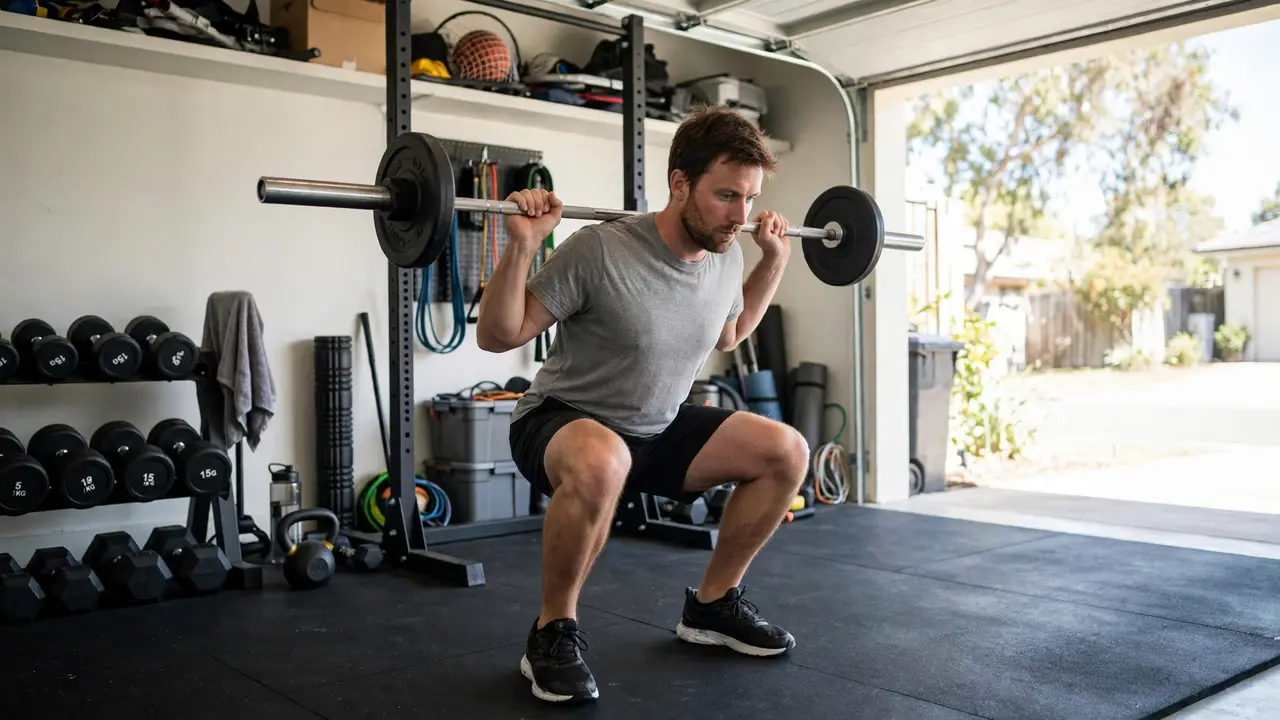
Beginner Strength Training Program for Men: The Australian Guide
Starting a beginner strength training program for men is one of the highest-return decisions you can make for your body. Muscle isn’t just about how you look — it’s the organ of longevity. It keeps your bones dense, your metabolism humming, your blood sugar in check, and your back from giving out when you’re 60 and still want to move well.
The problem is that most beginner programs are either ripped from American bodybuilding forums or buried in jargon. This guide is written for Australian blokes training at home, at a 24/7 gym, or in a garage: what to lift, how often, how to add weight safely, and how to not burn out by week three. It follows the Australian Government’s physical activity guidelines, which recommend muscle-strengthening activities on two or more days each week for adults aged 18–64.
Disclaimer: This is general information only, not medical advice. If you have a health condition, an injury, or haven’t exercised in a long time, check with your GP or an accredited exercise physiologist before starting a new training program.
Why Strength Training Should Come Before Cardio
If you’re choosing where to spend your first three months, strength training wins for most blokes. Here’s why. After about 30, men lose roughly 3–8% of their muscle mass per decade — a process called sarcopenia — unless they lift. Resistance training is the single most effective intervention to slow or reverse it. Cardio is excellent for your heart, but it doesn’t build the muscle and bone that keep you independent later in life.
Practically, strength training also changes your body composition faster than running alone. More muscle means a higher resting energy burn, which makes fat loss easier over months, not weeks. And unlike marathon-style cardio, a good lifting session takes 45 minutes, three times a week. That’s a schedule a working bloke can actually sustain.
That doesn’t mean cardio is optional. The best approach is lifting as your foundation with walking or an easy cardio session layered in. If you’re currently doing zero exercise, even two lifting days a week will transform how you feel within a month.
Beginner Strength Training for Men: The Full-Body Program
For the first 8–12 weeks, a full-body program beats a “bro split” (chest day, arm day, etc.) for beginners. You’ll practice the big movements more often, which builds skill faster, and each muscle gets hit three times a week instead of once. The schedule is simple: train Monday, Wednesday, Friday — or any three non-consecutive days. Rest days matter; muscle is built between sessions.
Each session uses the same six movement patterns, alternating between an “A” and “B” workout so you’re not repeating the exact same lifts every time:
Workout A
- Goblet squat — 3 sets of 8–10 reps
- Dumbbell bench press — 3 sets of 8–10 reps
- One-arm dumbbell row — 3 sets of 10 reps per arm
- Romanian deadlift — 3 sets of 8–10 reps
- Standing overhead press — 2 sets of 8–10 reps
- Plank — 3 rounds of 30–45 seconds
Workout B
- Split squat (or reverse lunge) — 3 sets of 8 reps per leg
- Push-up (elevated if needed) — 3 sets of as many as you can with good form
- Lat pulldown or assisted pull-up — 3 sets of 8–10 reps
- Hip thrust or glute bridge — 3 sets of 10–12 reps
- Dumbbell curl — 2 sets of 10–12 reps
- Dead bug — 3 sets of 8 reps per side
Rest 60–90 seconds between sets on upper-body moves, 90–120 seconds on lower-body moves. The whole session should take 45–60 minutes. If you only have dumbbells, every exercise above works — adjustable dumbbells are the space-saving pick for most home setups.
How to Pick Your Starting Weights
Your first week is a calibration week, not a test of manhood. Choose a weight that lets you finish all sets and reps with two or three reps “left in the tank.” You should feel the muscles working by the final set, but your form shouldn’t fall apart.
A rough starting guide for a healthy, untrained man:
- Goblet squat: 10–15 kg dumbbell or kettlebell
- Dumbbell bench press: 7.5–12.5 kg per hand
- One-arm row: 10–15 kg
- Romanian deadlift: 12.5–20 kg per hand (or 30–40 kg barbell)
- Overhead press: 5–10 kg per hand
These are starting points, not targets. If they feel silly-easy, go up. If the last reps look wobbly, go down. Nobody in the gym is watching you, and if they are, they’re not thinking what you think. For a detailed breakdown of safe lifting technique on the king of lifts, master the hip hinge with light weight before you load a bar.
The Progression Rule That Actually Builds Muscle
Muscle grows when it’s asked to do slightly more than last time. This is called progressive overload, and for beginners it’s beautifully simple: when you can complete all sets and reps of an exercise with good form, add a small amount of weight next session — 1.25 to 2.5 kg on upper-body lifts, 2.5 to 5 kg on lower-body lifts.
Write your numbers down. A notes app is fine. Without a log, you’ll guess, and guessing stalls progress. A beginner on this program can reasonably expect to add weight to most lifts every week for the first two to three months. That’s normal — enjoy it, because it won’t last forever.
When you eventually can’t add weight week to week (usually around month 3–4), switch to adding reps first: work up to the top of the rep range, then increase weight and drop back to the bottom of the range. This “double progression” can carry you for a year or more.
What to Do Before You Lift: The 8-Minute Warm-Up
Skip the treadmill jog. A proper warm-up raises your body temperature and rehearses the movements you’re about to do under load. Eight minutes, every session:
- 2 minutes — easy movement: brisk walk, bike, or march on the spot
- 2 minutes — leg swings (10 each leg, front-to-back and side-to-side) and arm circles
- 2 minutes — bodyweight squats, push-ups, and hip hinges (10 each, easy pace)
- 2 minutes — warm-up sets of your first exercise: one set of 10 with a light weight, one set of 5 with a moderate weight
Your first “real” set should never be the first time you feel that weight in your hands. Warm-up sets also let you check that your shoulders, knees, and back feel right today — some days they won’t, and that’s information, not failure.
Eating to Support Beginner Strength Training for Men
You don’t need a meal plan, a macro calculator, or a supplement stack. You need enough protein and enough total food. Sports-nutrition research commonly uses a protein range of around 1.6–2.2 grams per kilogram of body weight per day for people training to build muscle. Treat that as general information, not a personal prescription. For an 85 kg bloke, that’s roughly 135–185 grams daily — achievable with ordinary food: eggs and Greek yoghurt at breakfast, a palm-and-a-half of meat or fish at lunch and dinner, and milk or a tin of tuna as a snack.
If you’re trying to lose fat while building muscle (a realistic goal for beginners), eat at a modest deficit — about 300–500 calories under maintenance — and keep protein high. You’ll likely still get stronger for months because your nervous system is learning the movements. Don’t chase rapid weight loss and heavy lifting gains simultaneously; pick the main goal, let the other be a bonus.
Sleep is the third pillar. Seven to nine hours, consistently. The Australian guidelines recommend 7–9 hours of good-quality sleep for adults 18–64, and it’s not a footnote — growth hormone pulses during deep sleep, and training adaptations are consolidated overnight. A bloke sleeping five hours will stall out where a bloke sleeping eight keeps progressing.
Common Beginner Mistakes (and How to Dodge Them)
Mistake 1: Too much, too soon. Adding extra exercises, extra days, or maxing out in week two. The program works because it’s repeatable. Add complexity only when the basics stall.
Mistake 2: Program-hopping. Switching routines every three weeks because a YouTuber promised faster gains. Any sensible program works for 8–12 weeks. Your job is consistency, not optimisation.
Mistake 3: Ignoring pain vs. discomfort. Muscle burn and next-day soreness are normal. Sharp, pinching, or joint pain is not. If something hurts in a joint, stop that exercise and see a physio. Training through joint pain is how a six-week program becomes a six-month rehab.
Mistake 4: No rest days. Lifting every day as a beginner is like revving an engine with no oil. Your body adapts when you rest. Three days of lifting, four days of living — that’s the deal. Recovery is when the adaptation happens — protect it.
Mistake 5: Skipping legs. We all know the meme. Don’t be the meme. Your legs and glutes are the biggest muscles in your body; training them drives the most total growth and keeps your knees and back healthy.
What to Expect: A Realistic Timeline
Weeks 1–2: Soreness. You’ll be sore in muscles you forgot existed. This fades as your body adapts — it’s not a sign you should stop.
Weeks 3–6: The weights start climbing weekly. You’ll notice you stand taller and stairs feel easier. Don’t be surprised if your clothes fit slightly differently.
Weeks 7–12: Visible changes if your food and sleep are in order. Friends may comment. This is also when motivation dips for many blokes — the novelty wears off. This is exactly when the habit matters most.
Months 4–6: You’re no longer a beginner in the gym sense. Time to consider a program with more structure — an upper/lower split or a simple push/pull/legs rotation — but only if the full-body sessions feel stale, not just because you’re bored.
One more expectation to set: you will have bad sessions. Everyone does. A bad session where you show up and do 70% beats a skipped session every time. The program rewards attendance above all else.
Home vs Gym: Where Should You Train?
A commercial gym gives you barbells, racks, and machines — the full toolbox. But plenty of blokes build serious strength at home with adjustable dumbbells, a bench, and a pull-up bar. The program above was designed to work in both settings.
If you’re training at home, invest in the floor first (rubber mats save your tiles), then dumbbells, then a bench. Start with mats, dumbbells and a bench before anything fancy. If you’d rather join a gym, our men’s only gyms guide looks at who they suit and what to check before signing.
The honest answer: the best place to train is the one you’ll go to consistently. A garage you use three times a week beats a premium gym you visit twice a month.
FAQs
How long should a beginner strength training session take?
Around 45–60 minutes including warm-up. If you’re regularly taking 90 minutes, you’re resting too long or doing too many exercises. Three full-body sessions a week at this length is plenty for the first 3–6 months.
Can I build muscle with just dumbbells at home?
Yes, especially as a beginner. Adjustable dumbbells cover the full program above. You’ll eventually outgrow them on lower-body lifts like squats and deadlifts — at that point, a barbell setup or gym membership makes sense.
Should I do cardio on rest days?
Light cardio like walking is great on rest days and won’t hurt recovery. Keep hard cardio (sprints, intense cycling) away from heavy leg days — or do it after lifting, not before, so your legs are fresh for the weights.
How do I know if my form is right?
Film yourself from the side on your phone and compare against reputable technique videos. Better yet, book one session with a qualified coach or exercise physiologist to check your squat, hinge, press, and row. One hour of coaching early saves months of bad habits.
Is it too late to start lifting in my 40s or 50s?
Not at all. Research consistently shows adults in their 40s, 50s, 60s and beyond build muscle and strength with resistance training. Start lighter, warm up thoroughly, and progress a little more conservatively. See our healthy aging for men guide for the bigger picture after 40.
Keep Reading
New to beginner strength training? These three reads build on the program above.
- Men’s Only Gyms — who they suit and what to check first.
- Chicken Thigh Nutrition — an affordable protein staple, broken down.
- Healthy Aging for Men — staying strong past 40.