Push-Up Progression: From Zero to 50 (The Complete Plan)
Push-Up Progression From Zero to 50 (The Complete Plan)
A proper push-up progression from zero to 50 is one of the most satisfying fitness projects a bloke can take on. No gym, no gear, no membership — just you, the floor, and a plan. Push-ups build your chest, shoulders, triceps, and core in one movement, and the ability to knock out 50 clean reps is a genuine marker of upper-body strength and muscular endurance.
Most blokes fail at this because they start at the wrong level. If you can’t do five good push-ups, attempting sets of twenty just rehearses bad form and sore shoulders. This guide starts wherever you actually are — even if that’s a wall — and walks you up, step by step, to fifty unbroken reps.
Disclaimer: General information only. If you have shoulder, wrist, or chest pain, or a heart condition, check with your GP or physio before starting.
Why the Push-Up Deserves Your Respect
The push-up is often dismissed as a warm-up exercise, which is a mistake. A full push-up loads your chest, front shoulders, and triceps with roughly 65% of your body weight — for a 90kg bloke, that’s nearly 60kg per rep. Done with strict form, it’s a serious strength movement. Done for high reps, it builds the kind of muscular endurance that carries over to everything from lifting to manual work to keeping up with the kids.
It’s also the most honest exercise in existence. There’s no machine to blame, no spotter to assist, no weight stack to misread. You either move your body through space with control, or you don’t. That honesty is why military units, martial arts gyms, and footy clubs have used it as a benchmark for a century.
Fifty unbroken push-ups with good form puts you in roughly the top 10–15% of adult men for upper-body endurance. It’s an ambitious but entirely achievable target for a healthy bloke willing to train consistently for 3–6 months.
First: Learn What a Real Push-Up Looks Like
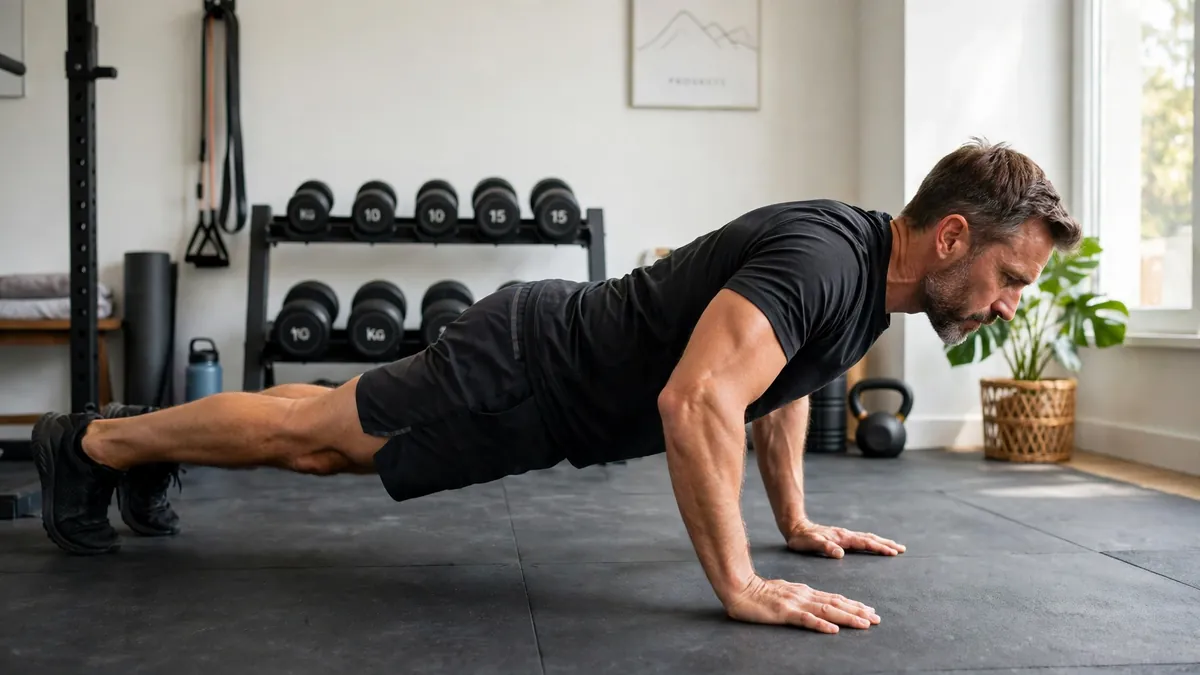
Before chasing numbers, get the movement right. A sloppy push-up trains sloppy patterns and irritated shoulders. The standard:
- Hands under your shoulders, fingers spread, gripping the floor.
- Body in a straight line from head to heels — squeeze your glutes and brace your abs like someone’s about to poke your stomach.
- Elbows at roughly 45 degrees from your torso — not flared out to 90 degrees (shoulder killer) and not pinned to your ribs.
- Chest lowers until it’s a fist’s height from the floor, or lightly touches it.
- Push the floor away, keeping that rigid body line — no sagging hips, no piking your backside up.
- Head neutral — look at the floor slightly ahead of your hands, not craning up or tucking your chin.
Film yourself from the side. What you feel and what you’re doing are often two different things — the camera doesn’t lie. If your hips sag, your core is the weak link; if your elbows flare, drop to an easier variation and rebuild. For more on building the midline strength that keeps your push-ups honest, see our core strength guide.
Push-Up Progression From Zero to 50: The 7-Level Ladder
Work through these levels in order. You “graduate” a level when you can do 3 sets of 15 clean reps with 90 seconds rest. Don’t skip levels — each one builds the tendon and joint capacity the next one demands.
Level 1: Wall Push-Ups
Stand arm’s length from a wall, hands on the wall at shoulder height, and push. If you can’t do 3×15 here, start here without shame — everyone’s starting point is valid. Most blokes spend 1–2 weeks at this level.
Level 2: Incline Push-Ups (High)
Hands on a kitchen bench or sturdy table. Same movement, more load. Spend 2–3 weeks here building to 3×15.
Level 3: Incline Push-Ups (Low)
Hands on a coffee table, sturdy chair, or the second stair step. The lower the surface, the harder the rep. This is where real chest and shoulder work begins — expect 2–4 weeks.
Level 4: Knee Push-Ups
On the floor, knees down, body straight from knees to head. The classic regression — and a perfectly legitimate training tool, not a cop-out. 2–4 weeks.
Level 5: Full Push-Ups
The real thing. If you can do 5–10 clean reps here on day one, you started at the right place by reading the earlier levels anyway — they’ll be your warm-up and back-off work. Build to 3×15 over 4–8 weeks.
Level 6: Volume Building (15 → 35)
Once you own 3×15, stop adding variations and start adding reps. The weekly plan below takes you from 15 to 35 unbroken reps.
Level 7: The Push to 50
From 35 to 50 is a grind of density and endurance work. The final plan below gets you there.
The Training Plan: 3 Days a Week
Train this push-up progression from zero to 50 three non-consecutive days per week (Mon/Wed/Fri works). Each session has the same structure but the numbers climb weekly. Always warm up with 2 minutes of arm circles, band pull-aparts if you have them, and one easy set at two levels below your working level.
Session structure:
- Set 1: 60% of your max reps (test your max once at the start)
- Set 2: 70% of your max reps
- Set 3: 80% of your max reps
- Set 4: 60% of your max reps
- Set 5: As many clean reps as possible (stop 2 reps before failure)
Rest 90 seconds between sets. Each week, add 1–2 reps to each set. Retest your max every four weeks and recalculate. This “grease the groove” style volume — frequent, submaximal, perfect reps — is how endurance is actually built. One all-out set to failure per session is plenty; training to failure on every set just fries your shoulders and stalls progress.
On non-push-up days, do your normal training — this plan slots neatly into our no-gym bodyweight program or alongside any lifting routine, such as our beginner strength training program for men. Just don’t do heavy chest work the day before a push-up session.
Breaking Plateaus: When the Numbers Stall
Everyone stalls somewhere — usually around 20–25 reps and again around 35–40. Here’s the fix for each:
Stuck at 20–25: Your triceps are the limiter. Add close-grip push-ups (hands directly under your chest) for 3 sets of 8–12 twice a week. Also check your bodyweight — every kilo lost is a kilo less to push.
Stuck at 35–40: This is a muscular endurance wall. Switch one weekly session to “density” work: set a timer for 10 minutes and do a set of 10 perfect push-ups every minute on the minute. Rest the remainder of each minute. When that feels easy, go to 12 reps per minute.
General plateau busters: add a weighted vest or a backpack with books for 3×8 twice a week (strength carries over to endurance); do slow-tempo push-ups (3 seconds down, 1 second pause, explode up) to build control; and make sure you’re sleeping enough — endurance adaptations consolidate overnight just like strength ones.
The other plateau cause nobody wants to hear: you’re not eating enough. High-rep push-up training burns real calories. If your weight is dropping and your reps are stuck, add a few hundred calories a day — mostly protein and carbs — and watch the numbers move.
Variations to Keep It Interesting (After 25 Reps)
Once you can do 25 clean standard push-ups, variations keep training fresh and build well-rounded strength. Rotate one or two of these into your sessions:
- Close-grip push-ups — hands under your chest, elbows brushing your ribs. Triceps destroyer.
- Wide push-ups — hands wider than shoulders. More chest emphasis.
- Decline push-ups — feet on a chair or step. Shifts load to the upper chest and shoulders.
- Diamond push-ups — thumbs and index fingers forming a diamond under your chest. Advanced triceps work.
- Archer push-ups — one arm straight out to the side while the other does most of the work. The bridge to one-arm push-ups.
- Plyometric push-ups — push explosively so your hands leave the floor. Power development; only when your base is solid.
A warning: flashy variations (one-arm, clapping, planche attempts) are fun but they’re party tricks until your base is deep. Build the base first. Fifty clean standard reps is more impressive — and more useful — than three ugly one-arm reps.
Common Form Faults That Cap Your Numbers
Hips sagging. The number-one fault. Fix: squeeze glutes hard throughout, and do planks and dead bugs to build the core endurance that holds the line for 50 reps.
Elbows flaring to 90 degrees. Puts the shoulder in a vulnerable position and bleeds power. Fix: think “screw your hands into the floor” — this external rotation cue tucks the elbows naturally.
Half reps. Chest stopping 15cm from the floor. Fix: put a fist, a tennis ball, or a rolled towel under your chest as a depth target until full range is automatic.
Neck craning. Looking forward at a mirror instead of down. Fix: pick a spot on the floor about 30cm ahead of your hands and stare at it.
Holding your breath. Breathe in on the way down, out on the way up. Holding your breath spikes blood pressure unnecessarily — fine for a 1-rep max deadlift, pointless for rep 37 of push-ups.
What a Push-Up Progression From Zero to 50 Actually Means for Your Fitness
Let’s be honest about what this achievement is and isn’t. Fifty push-ups demonstrates excellent muscular endurance, solid core control, and healthy shoulders. It’s correlated with good cardiovascular fitness too — a well-known study of firefighters found push-up capacity was inversely associated with cardiovascular events. It’s a legitimate fitness marker, not just a party trick.
What it isn’t: a complete fitness program. Push-ups don’t train your back, your legs, or your heart at vigorous intensity. The bloke who can do 50 push-ups but can’t run a kilometre or do a single pull-up has gaps. Use this project as a gateway — it proves you can commit to a plan and progress — then round out your training with pulling, legs, and cardio. Australia’s physical activity guidelines recommend muscle-strengthening on two or more days weekly plus regular moderate-to-vigorous activity — the Better Health Channel’s sport and physical activity guide is a solid, government-backed starting point for building that complete routine. Our 30-minute full-body workout is the natural next step for time-poor blokes.
Testing Day: How to Measure Your Max Properly
Every four weeks, test your unbroken max to recalibrate your push-up progression from zero to 50. Warm up thoroughly, rest 5 minutes, then do one all-out set of perfect push-ups — stopping when your form breaks, not when you collapse. That number is your new baseline; recalculate your five working sets from it. Don’t test weekly: max testing is fatiguing and the weekly rep additions already tell you you’re improving. One more rule — test at the same time of day and in the same conditions each time. A max done fresh on Saturday morning isn’t comparable to one done tired on Friday night, and comparing incomparable numbers just confuses the plan.
FAQs
How long does a push-up progression from zero to 50 take?
For a healthy, untrained man training three days a week: roughly 3–6 months. If you start at knee push-ups, expect 3–4 months. If you start at wall push-ups, closer to 6. Consistency matters more than starting level.
Should I do push-ups every day?
No — three non-consecutive days per week is better for most blokes. Daily max-effort push-ups beat up the shoulders and elbows. If you want daily practice, keep it to one easy submaximal set (grease-the-groove style), well short of failure.
Why do my wrists hurt during push-ups?
Wrist pain usually comes from poor wrist mobility or dumping weight into extended wrists. Try push-ups on dumbbell handles or parallettes to keep wrists neutral, warm up your wrists with circles and stretches, and build volume gradually.
Are knee push-ups real push-ups?
They’re a legitimate regression, not a lesser exercise. Studies show knee push-ups activate the same muscles as full push-ups at a lower intensity. They’re the correct tool for building up to full push-ups — use them proudly.
Will push-ups build my chest?
They’ll build your chest, shoulders, and triceps, especially in the first year of training. For maximum chest growth long-term, you’ll eventually want heavier loading (weighted push-ups, bench press), but 50 clean reps builds a solid foundation most blokes never achieve.