Best Home Gym Setup Australia: The Budget Guide for 2026
Best Home Gym Setup Australia: The Budget Guide for 2026
A proper home gym setup in Australia on a budget doesn’t need to cost thousands. For the price of a year of gym membership, you can build a training space in your garage, spare room, or even a corner of the lounge that serves you for a decade. This home gym setup Australia budget guide shows you how. The trick is buying in the right order — and skipping the shiny gear that gathers dust.
This guide lays out exactly what to buy first, what to skip, and what each tier costs in Australian dollars based on current retailer pricing. No sponsored picks, no affiliate fluff — just the gear that earns its floor space.
Disclaimer: General information only. Check weight ratings and flooring requirements before loading heavy gear, and see your GP if you have a health condition that affects exercise.
Why a Home Gym Setup Australia Budget Pays for Itself
Do the maths. A mid-range Australian gym membership runs roughly $25–$35 a week — that’s $1,300–$1,800 a year, every year, plus joining fees and the commute. A basic home gym costing $800–$1,000 breaks even in under a year, and the gear keeps working for a decade or more.
The less obvious win is consistency. The number-one predictor of whether a bloke keeps training is friction: how hard it is to start a session. A garage gym removes the commute, the parking, the peak-hour wait for the squat rack, and the “I’ll go tomorrow” excuse. You can train in your socks at 6am or 10pm. For shift workers, parents, and blokes in regional Australia with no decent gym nearby, that convenience is the whole game.
None of this means commercial gyms are bad — if you love the atmosphere, keep your membership. But if the drive is the reason you keep quitting, the garage is calling.
The Golden Rule: Buy in This Order
Beginners blow money on the wrong things: a fancy bench before they own weights, a cable machine before they can do ten push-ups. Follow this order and every dollar works:
- Flooring — protects your floor and your gear
- Adjustable dumbbells — the single most versatile purchase
- Flat/incline bench — unlocks pressing and rows
- Pull-up bar — the best upper-body builder you can bolt to a wall
- Kettlebell — swings, goblet squats, carries
- Barbell + rack + plates — the serious-lifter upgrade
- Cardio piece — rower, bike, or skipping rope (last, not first)
Notice cardio is last. Cardio equipment is the most common home-gym regret purchase — treadmills become clothes racks because running outside is free. Strength gear gets used because it’s the workout you can’t do without equipment.
Tier 1: The Starter Setup (~$300–$600)
This tier covers everything a beginner needs for the first 6–12 months. You’ll be able to run a complete full-body strength program — see our beginner strength program — with zero compromises.
- Rubber floor mats (4–6 tiles) — interlocking EVA or rubber tiles from Bunnings or Kmart run about $10–$20 per tile. Get 6 for a 2m x 2m training area.
- Adjustable dumbbells — a spinlock pair with weight plates is the cheapest entry (often under $150 for the set at Kmart or Big W). Dial-adjustable sets cost more but save huge time.
- Doorway pull-up bar — $40–$80 at Rebel Sport or Amazon AU. Check your door frame first; lever-style bars suit most standard frames.
- Skipping rope — $15–$30. Covers your cardio for now.
- Resistance bands (set) — $30–$60. Useful for warm-ups, assisted pull-ups, and adding resistance to push-ups.
Total: roughly $300–$600 depending on sales. That is less than six months of most gym memberships, and it never expires.
Tier 2: The Committed Setup (~$800–$1,500)
Once you’ve trained consistently for six months and you’re outgrowing spinlock dumbbells, step up. This tier is the sweet spot for most blokes — it handles years of progression.
- Quality adjustable dumbbells — dial-style adjustable pairs (the kind that replace a whole rack) typically run several hundred dollars in Australia. Check current prices at Rebel Sport, Force USA, or Rogue Australia before buying; prices move with sales.
- Adjustable bench (flat/incline) — $200–$400 for a solid bench rated to 250kg+. Don’t buy the cheapest bench you can find; a wobbly bench is a safety issue.
- Kettlebell (16kg or 20kg) — budget cast-iron or concrete-filled bells start around $60–$70 for 16kg at Australian online retailers like Factory Buys; premium single-cast bells from Rogue Australia or Force USA cost more but last forever.
- Wall-mounted pull-up bar or power tower — $100–$250. More stable than doorway bars for heavier blokes.
- Weight vest (optional) — $80–$150. Turns bodyweight work into serious training.
At this tier you can train every major movement pattern with progressive overload for years. Most men never need more than this. Our kettlebell beginner guide shows you how to get the most from a single bell.
Tier 3: The Serious Lifter (~$1,500–$3,000+)
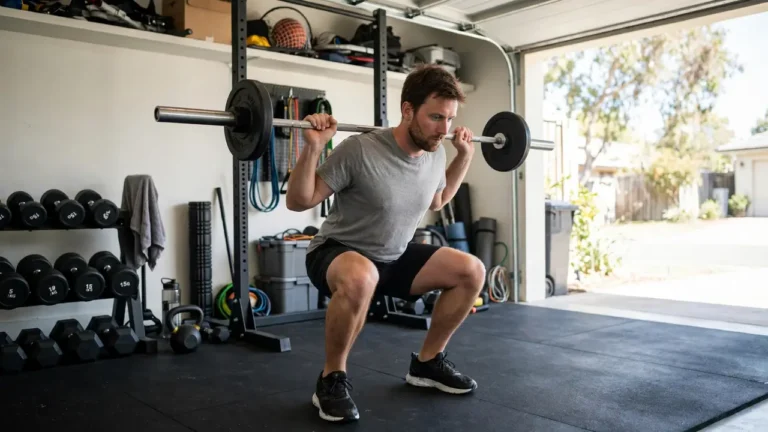
This is the “never need a gym again” setup: a barbell, a rack, and enough plates to keep progressing for years.
- Power rack or squat stands — $400–$900 in Australia. A full power rack with safety arms is the safest way to squat and bench press alone.
- Olympic barbell (20kg) — $200–$450. Look for 28–29mm shaft, knurling that isn’t cheese-grater aggressive, and a 700lb+ rating.
- Bumper plates or iron plates (100–140kg set) — $300–$700. Bumpers are quieter and floor-friendly; iron is cheaper per kilo.
- Horse-stall mats or 20mm+ rubber flooring — proper thick rubber for dropping weights safely.
- Cardio machine — a Concept2 RowErg is the gold standard; Australian retailers list new units around $1,400–$1,600, with Rebel Sport’s RRP at $1,899 (used ones go for far less on Gumtree and Facebook Marketplace). Alternatively, a magnetic exercise bike from Rebel Sport starts around $399 for a Celsius model — see our home cardio equipment guide.
Buy the rack and barbell secondhand if you can. Barbells and racks barely wear out, and Gumtree and Marketplace are full of near-new gear from blokes whose motivation lasted three weeks. Their loss, your gain — inspect welds and check the bar spins freely before handing over cash.
What NOT to Buy (the Regret List)
Ab machines. Ab rollers, crunch benches, electric ab belts — your core gets trained by squats, deadlifts, and planks. Save the money.
All-in-one cable stations (cheap ones). Budget cable machines have terrible resistance curves and wobble. A good one costs $2,000+. Bands do 80% of the job for $50.
A treadmill (for most people). Unless you genuinely love running indoors, you’ll use it for a month. Walk or run outside — it’s free and better for you.
Anything before you have flooring. Dropping a dumbbell on tiles or floorboards is a $500 mistake. Mats first, always.
Matching brand sets. Nobody cares if your plates match your bar. Buy the best value per piece.
Space Planning: How Much Room Do You Actually Need?
You need less space than you think. A 2m x 2m square handles dumbbell training, kettlebells, bands, and bodyweight work comfortably. For a barbell setup with a rack, allow 3m x 3m so you can load plates and walk out a squat safely. Measure your ceiling too — you need roughly 2.4m of clearance for overhead pressing, and more if you’re tall.
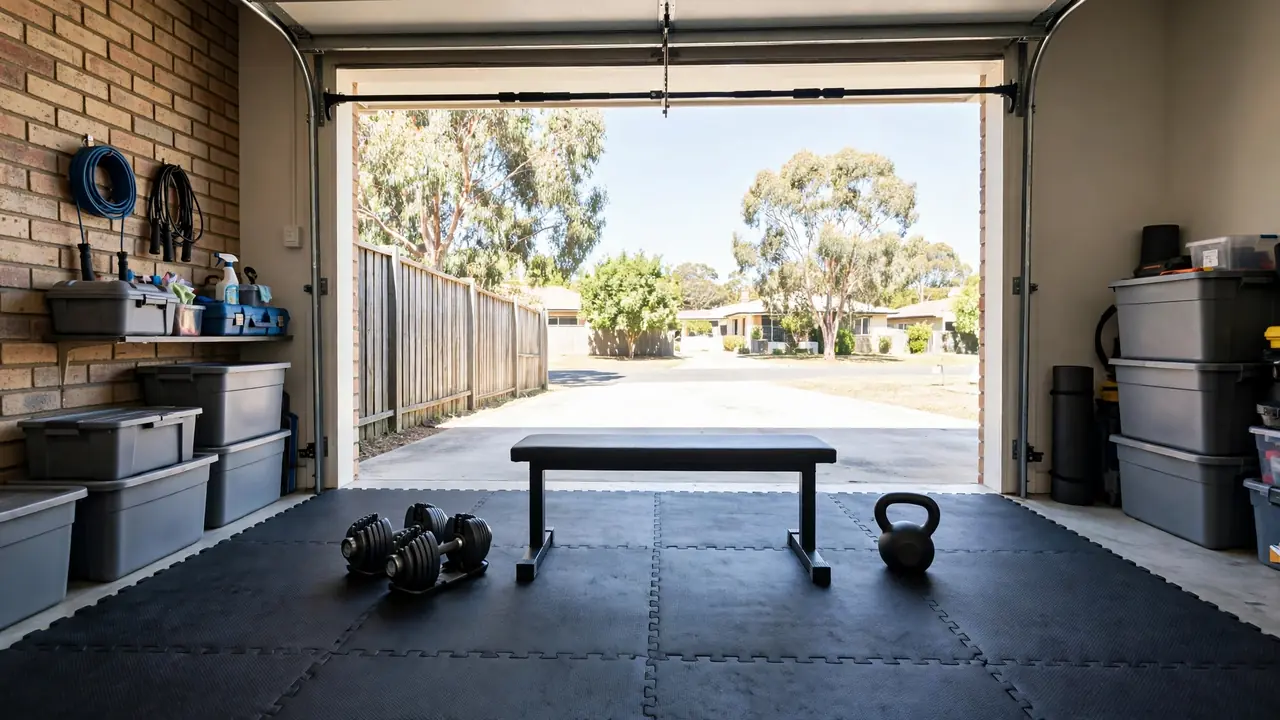
Garages are the classic Aussie home gym: concrete floors (easy), ventilation (open the roller door), and nobody cares about noise. Spare rooms work if the floor can take it — put down thick rubber and keep heavy deadlifts in the garage. Apartments are trickier: stick to dumbbells, bands, and bodyweight, and keep the jumping to a minimum for your downstairs neighbours.
Where to Buy Gym Gear in Australia
The main players: Rebel Sport (biggest range in-store, frequent sales), Kmart and Big W (cheapest entry-level gear), Force USA (Australian company, excellent mid-range racks and benches), Rogue Australia (premium, based in Ingleburn NSW), Gym and Fitness (good online range), and Factory Buys (budget-friendly online). For secondhand: Gumtree and Facebook Marketplace, where commercial-grade gear sells for half price.
Check prices across at least two or three of these before buying anything over $200 — sales cycles are frequent, and EOFY and Black Friday routinely knock 20–30% off big-ticket items. Prices in this home gym setup Australia budget guide were current at the time of writing; always confirm before you buy.
Keeping It Safe: The Non-Negotiables
Training alone means safety is on you. Use safety arms or spotter arms on your rack for every squat and bench press — set them just below your lowest position. Learn how to bail from a failed squat (throw the bar behind you and step forward) before you ever need to. Bolt tall racks to the floor or wall; an unanchored rack can tip.
Ventilation matters in an Aussie garage summer — a $50 pedestal fan beats heat exhaustion. Keep a phone within reach, tell someone when you’re lifting heavy alone, and respect weight ratings on benches and bars. The Australian Competition and Consumer Commission’s Product Safety Australia site is worth a look for recalled fitness products before buying secondhand gear.
Sample $1,000 Shopping List (Tier 2, Done Right)
To make this concrete, here’s what a smart $1,000 spend looks like at typical Australian prices — the setup that covers 95% of lifters for years:
- Rubber mats (6 tiles): ~$90 from Bunnings or Kmart
- Dial-adjustable dumbbells: ~$450–$550 on sale at Rebel Sport or Force USA
- Adjustable bench: ~$250–$300 (look for 250kg+ rating)
- 16kg kettlebell: ~$65–$90 budget, more for premium cast iron
- Doorway or wall pull-up bar: ~$60–$120
- Resistance band set + skipping rope: ~$50 combined
That totals roughly $965–$1,170 — call it a grand. Every item gets used weekly; nothing sits in the corner. Compare that to the bloke who spends $1,000 on a single all-in-one machine and outgrows it in six months. Buy versatile, buy once.
Timing matters too. Australian retailers run their deepest fitness discounts around New Year (resolution season stock clearances), EOFY in June, and Black Friday in November. If you’re not in a rush, waiting six weeks for a 25% off sale on a $500 dumbbell set saves you $125 — that’s a kettlebell for free. Sign up for price alerts at the big retailers and pounce when the gear you want drops.
Maintaining Your Gear So It Lasts a Decade
Home gym gear is nearly indestructible if you do the basics. Wipe down benches and bars after sessions — Aussie sweat is salty and humidity rusts bare steel. A light coat of 3-in-1 oil on barbell sleeves every few months keeps them spinning. Tighten rack bolts twice a year; they loosen with vibration.
Store plates off damp concrete where possible — a simple timber rack or even stacked on a rubber mat prevents moisture damage. Keep resistance bands out of direct sunlight, which degrades the latex. And if you bought secondhand, give everything a deep clean and inspection on day one: check cables for fraying, benches for cracked welds, and dumbbell mechanisms for smooth adjustment before you trust them under load.
None of this takes more than an hour a year. Treat your gear like the investment it is and it’ll still be going strong when your kids are old enough to steal your dumbbells.
FAQs
How much does a home gym cost in Australia?
A home gym setup Australia budget starts at roughly $300–$600 for a starter setup, $800–$1,500 for a solid committed setup, and $1,500–$3,000+ for a full barbell setup. All three tiers pay for themselves within a year compared to a typical gym membership.
What is the first thing to buy for a home gym?
Flooring, then adjustable dumbbells. Mats protect your floor; dumbbells let you train every major movement. Everything else builds on those two purchases.
Is it cheaper to build a home gym or join a gym?
A home gym is cheaper within 12 months for most people. A $1,000 setup versus $1,300–$1,800 a year in membership fees — and the gear keeps working for years after it has paid for itself.
Can I build muscle with just dumbbells and a bench?
Yes. Dumbbells, a bench, and a pull-up bar cover every movement pattern a beginner to intermediate lifter needs. You’ll only outgrow them on heavy lower-body lifts after a year or more of consistent training.
Where is the best place to buy gym equipment in Australia?
Rebel Sport for range and sales, Kmart/Big W for budget basics, Force USA and Rogue Australia for quality strength gear, and Gumtree/Facebook Marketplace for secondhand bargains. Compare at least two or three before big purchases.