How to Train Around a Knee Injury: The Safe Approach (See a Physio First)
Train Around Knee Injury: The Safe Approach (See a Physio First)
Learning how to train around knee injury is one of the most valuable skills in fitness — because knees, especially in men over 30, will occasionally complain. The goal is simple: keep training everything that doesn’t hurt, maintain your fitness and sanity during recovery, and avoid turning a minor issue into a major one. This guide covers the principles, what you can safely do, what to avoid, and the red flags that mean professional help now.
Important: This is general information only — not medical advice and not a substitute for professional assessment. See a physiotherapist for any knee injury before following training advice. Training through an undiagnosed knee injury can cause serious, lasting damage. If you have swelling, locking, giving way, or inability to bear weight, see a professional promptly.
Step Zero: Get Assessed (Non-Negotiable)
Before anything else: see a physiotherapist. Not after a week of “seeing how it goes” — promptly. Here’s why: knee pain has many causes (meniscus issues, ligament sprains, patellofemoral pain, IT band syndrome, osteoarthritis, referred pain from the hip or back), and the correct training approach differs completely between them. What helps patellofemoral pain can worsen a meniscus tear. Generic advice — including this article — cannot diagnose your knee.
A good physio will diagnose the issue, tell you what’s safe to load, give you specific rehab exercises, and set a timeline. That 45-minute appointment ($80–$150 in Australia, with Medicare rebates available under a GP Chronic Disease Management plan for eligible patients) is the highest-value money in this entire process. In Australia, you can find registered physiotherapists through the Australian Physiotherapy Association at australian.physio.
Everything below on how to train around knee injury assumes you’ve been assessed and cleared for modified training. If you haven’t, stop here and book the appointment.
The Golden Rules of Training Around Injury
Rule 1: Train what’s trainable. A knee injury doesn’t sideline your upper body, your core, your other leg, or your cardiovascular system (via arms or the good leg). The blokes who come back fastest kept training everything else — maintaining fitness, muscle, routine, and mental health instead of detraining completely.
Rule 2: Pain is information — respect the scale. The widely used guideline: pain up to 3/10 during exercise that settles within 24 hours is generally acceptable in rehab contexts; pain above 5/10, pain that worsens during the session, or pain lingering beyond 24 hours means you did too much. Sharp, catching, or giving-way sensations are always stop signals regardless of the number. Your physio’s specific guidance overrides these general rules.
Rule 3: Swelling is the veto. Increased swelling after training means the joint didn’t tolerate the load — back off. A knee that swells is telling you the dose was wrong. Track swelling (compare knees visually, note sock marks) as objectively as you track weights.
Rule 4: Don’t create new problems. The classic error: overcompensating with the good leg until it breaks down too, or adopting such protective movement patterns that your back or hip starts hurting. Train symmetrically where possible, and address compensation patterns rather than cementing them.
Rule 5: Rehab exercises are training, not optional extras. The clamshells, terminal knee extensions, and step-downs your physio prescribes are the actual treatment. Do them with the same seriousness as your main lifts — they’re what gets you back.
What You CAN Train: The Full Menu
Assuming physio clearance, you can still train around knee injury — most of your body stays available:
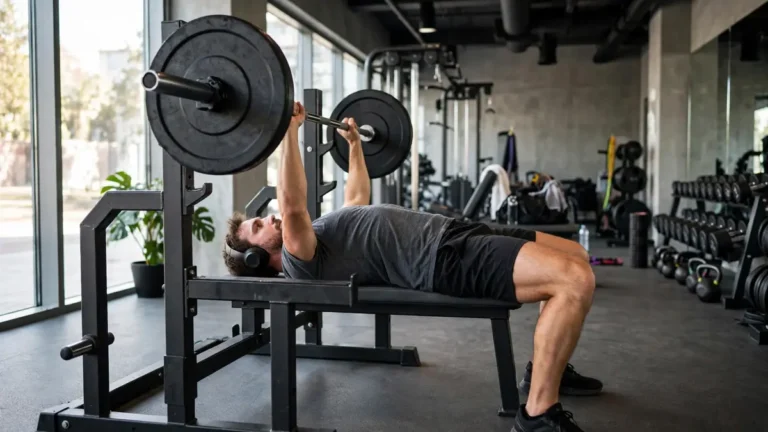
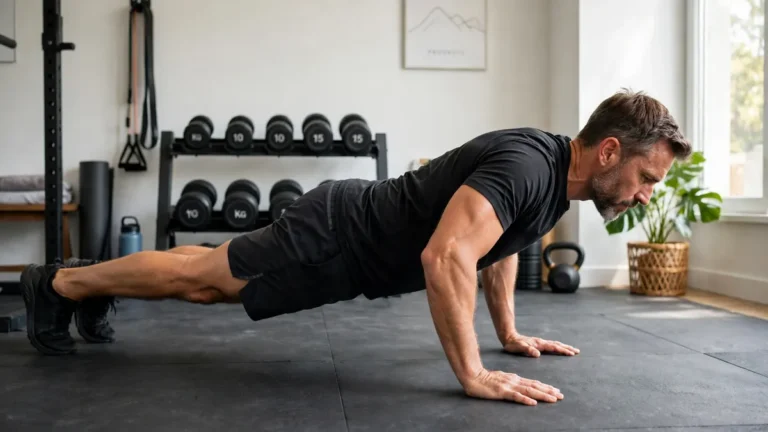
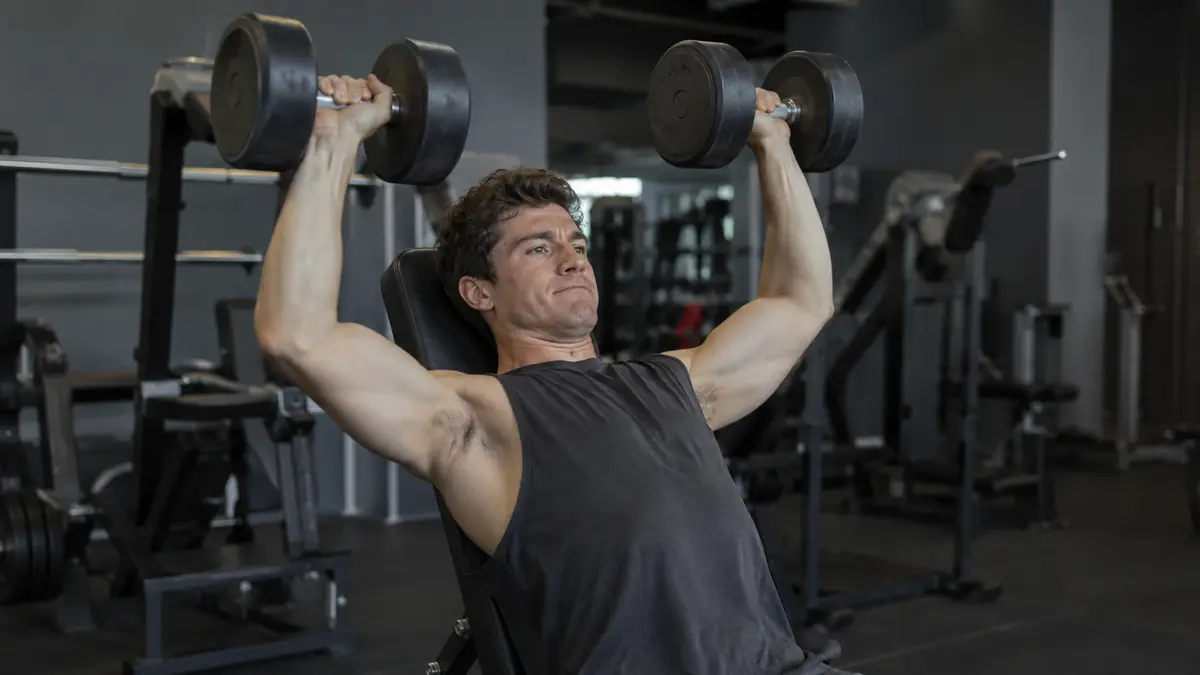
Upper body — train normally. Bench press, overhead press, rows, pull-ups, curls, push-ups — none of these load the knee (use a bench/seated position to avoid standing on the bad leg if needed). This is the time to bring up a lagging upper body. Our bench press guide and push-up progression give you plenty to work on.
Core — train normally. Dead bugs, Pallof presses, planks (on knees if needed), side planks, suitcase carries (light, if walking is tolerated). A strong core protects everything downstream — see our core guide for the full routine.
The uninjured leg — train it. Single-leg work on the good leg (split squats, step-ups, single-leg RDLs) maintains strength — and research on “cross-education” shows training one limb preserves some strength in the immobilised limb. Don’t skip this; it’s free strength insurance.
The injured leg — train what the physio allows. This is highly individual: it might be quad sets and straight-leg raises initially, progressing to terminal knee extensions, step-downs, and eventually loaded exercises through the physio’s protocol. Follow the protocol exactly — it’s dosed like medicine.
Cardio — adapt, don’t abandon. Options that spare the knee: upper-body ergometer (arm bike), swimming (if kicking is tolerated; otherwise pull-buoy arms-only), rowing (if the knee bends pain-free; often fine for patellofemoral issues), battle ropes, and boxing/pad work from a stable stance. The goal is maintaining cardiovascular fitness, which makes the return to full training easier.
What to AVOID (Until Cleared)
- Deep knee flexion under load — deep squats, lunges, leg press with knees to chest. The most common aggravator across knee conditions.
- Twisting/pivoting on a loaded knee — the mechanism behind most meniscus and ligament injuries. No agility work, no pivoting sports.
- Running and jumping — high impact forces; among the last things to return, via a graded running program from your physio.
- Kneeling directly on the injured knee — obvious, but blokes forget during floor exercises. Use a pad or modify.
- “Testing” the knee — the urge to “just see if squats are okay now” has derailed thousands of rehabs. Let the physio’s testing be the test.
- Complete rest beyond the acute phase — the opposite error. After the initial 48–72 hours (for acute injuries), prolonged complete rest weakens everything and stiffens the joint. Move what you can, as your physio directs.
Sample Training Week During Knee Rehab
Monday — Upper body push + core: dumbbell bench press 4×8, overhead press 3×10, push-ups 3× max, Pallof press 3×10/side, dead bugs 3×8/side. Plus physio rehab exercises.
Tuesday — Cardio + rehab: 20–30 min arm bike or swimming (as tolerated), then the full physio rehab routine. Finish with gentle mobility for everything except the injured knee.
Wednesday — Upper body pull + single-leg (good leg): pull-ups or lat pulldown 4×8, one-arm dumbbell rows 3×10/side, face pulls 3×15, good-leg split squats 3×10, good-leg single-leg RDL 3×8. Plus rehab exercises.
Thursday — rest or gentle walk (if walking is tolerated and cleared).
Friday — Full upper body + core: incline dumbbell press 3×10, barbell/dumbbell row 4×8, lateral raises 3×12, curls 3×12, suitcase carry (light) 3×40m, side planks 3×30s/side. Plus rehab exercises.
Weekend: one cardio session (as tolerated), one full rest day. Daily: the physio’s rehab routine — non-negotiable, like brushing teeth.
This isn’t a lesser week — it’s a focused upper-body and conditioning block. Reframe rehab as a training phase with different goals, not exile from training.
The Mental Game of Injury
Knee injuries mess with your head as much as your training. The identity threat (“I’m a bloke who trains” — see our consistency guide) collides with forced limitation, and the result is often frustration, low mood, or the all-or-nothing response: “if I can’t train properly, I won’t train at all.”
Fight that response with three reframes. One: you’re not injured-and-not-training; you’re in a rehab training phase with specific goals (maintain upper body, preserve cardio, do the rehab). Two: detraining is fast but retraining is faster — muscle memory is real, and the fitness you maintain now shortens the comeback. Three: many blokes return from injury-induced upper-body focus with a more balanced physique than before — the forced specialisation becomes an advantage.
Watch for the warning signs that it’s more than frustration: persistent low mood, sleep disruption, withdrawing from normal activities. Injury-related depression is common and treatable — talk to your GP. And if you’re struggling, Lifeline (13 11 14, 24/7) is there.
Returning to Full Training: The Graded Path
The return to full training after you train around knee injury isn’t a single day — it’s a weeks-long ramp, directed by your physio. Typical milestones (highly individual):
- Pain-free daily life — walking, stairs, sitting/standing without symptoms. The foundation; don’t skip it.
- Rehab exercises mastered — full physio protocol completed with good strength symmetry (often 90%+ of the good leg).
- Loaded bilateral exercises — goblet squats to box, leg press through comfortable range, Romanian deadlifts. Light, controlled, pain-monitored.
- Full range strength work — barbell squats, lunges, full leg training. Gradual loading over weeks.
- Impact reintroduction — walk-jog intervals, then running, then jumping/agility — each as its own graded progression.
- Sport-specific work — cutting, pivoting, contact — last, and only with physio clearance.
The rule at every stage: the knee’s response in the 24 hours after determines the next step. No swelling, no increased pain → progress. Any regression → hold or step back. Rushing this sequence is how 6-week injuries become 6-month sagas. Patience here is the active discipline of doing the right dose.
Red Flags: Stop Training and Get Help Now
Most knee niggles are manageable, but some signs demand prompt professional attention. Stop and book a physio or GP urgently if you experience:
- A pop at the time of injury followed by rapid swelling — the classic ACL presentation. Don’t walk it off; get assessed.
- The knee locks or catches — you can’t fully straighten or bend it, or something feels stuck. Suggests a mechanical issue (meniscus, loose body) that training won’t fix.
- Giving way — the knee buckles or feels unstable under load. Ligament involvement until proven otherwise.
- Significant swelling within hours of the injury — rapid swelling suggests bleeding into the joint (haemarthrosis), which warrants medical assessment.
- Inability to bear weight — if you can’t stand on it, it’s not a “niggle.” Get it looked at.
- Numbness, tingling, or foot drop — neurological symptoms are never normal with a knee injury.
- Fever, redness, or warmth around the joint — possible infection, which is a medical emergency in a joint.
- Pain that worsens over weeks despite rest and sensible management — something’s being missed; get a second opinion or imaging as your physio advises.
The through-line: mechanical symptoms (locking, giving way, popping) and rapid swelling are the two categories that most urgently need professional eyes. Everything else in this guide assumes you’ve been assessed and cleared — these red flags are the reason that assessment matters. When in doubt, get checked. Knees are load-bearing joints you’ll need for the rest of your life; a $120 physio appointment is cheap insurance for decades of function.
FAQs
Should I see a physio for knee pain or just rest it?
See a physio. Rest alone doesn’t diagnose the problem, and the correct approach differs completely between knee conditions. Early assessment leads to faster, safer recovery — and Medicare rebates may apply via a GP plan.
Can I still work out with a knee injury?
Yes — you can train around knee injury by training everything the physio clears: upper body, core, the good leg, adapted cardio, and the prescribed rehab exercises. Complete rest beyond the acute phase usually slows recovery.
What exercises should I avoid with a bad knee?
Until cleared: deep knee flexion under load, twisting/pivoting on the loaded knee, running and jumping, and kneeling on the injured knee. Your physio’s specific restrictions override any general list.
How long does a knee injury take to recover?
Highly variable: minor strains 2–6 weeks, patellofemoral pain 6–12 weeks with proper rehab, ligament/meniscus injuries months and sometimes surgery. Your physio gives you a timeline after assessment — beware anyone promising a date without examining you.
Will my knee ever be the same after injury?
With proper rehab, most knee injuries recover to full function — many athletes return to elite sport. The key variables are accurate diagnosis, diligent rehab, and not rushing the graded return. The blokes who do the boring rehab properly get the best outcomes.