Bodyweight Workout Plan: No Gym Needed (The Complete System)
Bodyweight Workout Plan No Gym Needed (The Complete System)
This bodyweight workout plan no gym needed proves you don’t need a gym to build real strength and muscle. No membership, no equipment, no excuses — just a floor, a wall, and optionally something to pull up on. What follows is a complete system with three progressive levels, full routines, and the progression methods that keep bodyweight training effective long after the beginner gains.
Disclaimer: General information only. Check with your GP or physio if you have injuries or health conditions affecting exercise.
Why Bodyweight Training Works (When Done Right)
The knock on bodyweight training is that it’s “not enough” for building muscle. That’s true of random push-ups and sit-ups — and false of programmed bodyweight training. Muscle responds to tension, fatigue, and progression, not to iron specifically. Gymnasts build extraordinary physiques with bodyweight alone because they train with high tension, strict form, and relentless progression.
The advantages are practical: zero cost, train anywhere (hotel rooms, parks, backyards), no commute, joint-friendly loading you can scale precisely, and movements that build coordination alongside strength. Lockdowns proved a well-structured bodyweight routine can maintain fitness anywhere.
The honest limitations: legs are hard to load heavily without weights, and progressive overload needs more creativity than “add 2.5kg.” This plan addresses both. And when you eventually want heavier leg loading, our dumbbell guide or kettlebell guide are the natural next purchases — but they’re wants, not needs, for the first 6–12 months.
The Movement Foundation: 6 Patterns, Zero Equipment
Every good program covers six fundamental movement patterns. Here’s the bodyweight workout plan no gym version of each, with progressions:
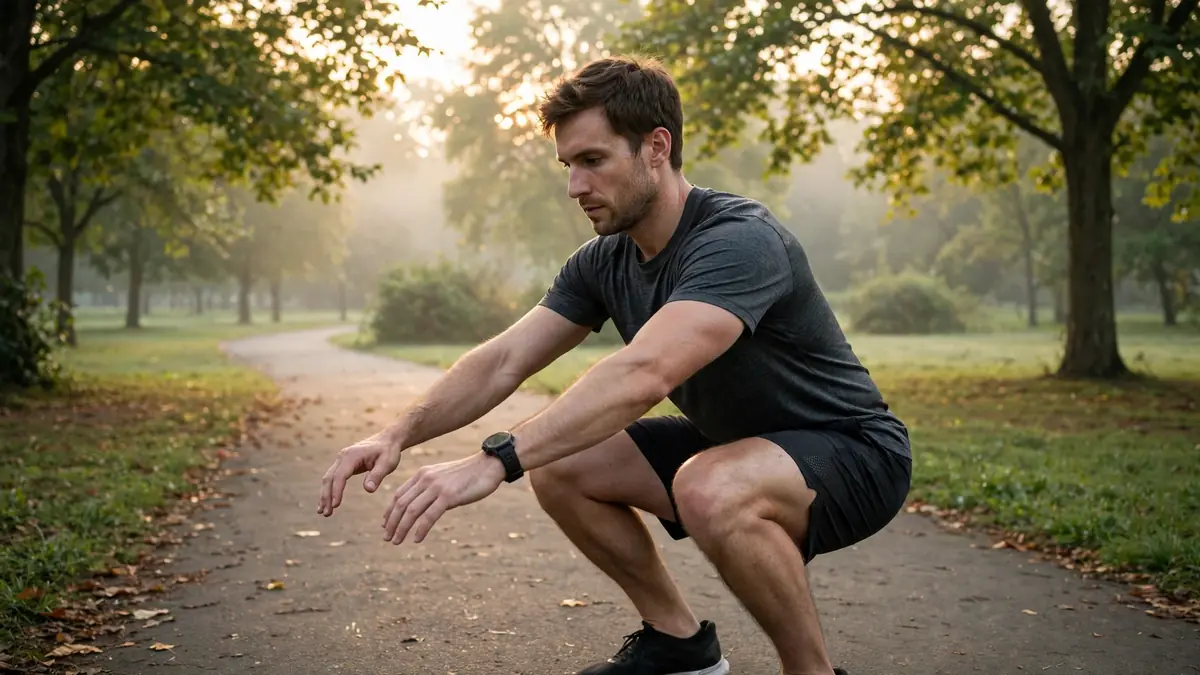
- Squat: bodyweight squat → split squat → Bulgarian split squat → pistol squat (assisted → full). Legs and glutes.
- Hinge: glute bridge → single-leg glute bridge → Romanian deadlift pattern (bodyweight hip hinge) → Nordic curl negatives. Posterior chain.
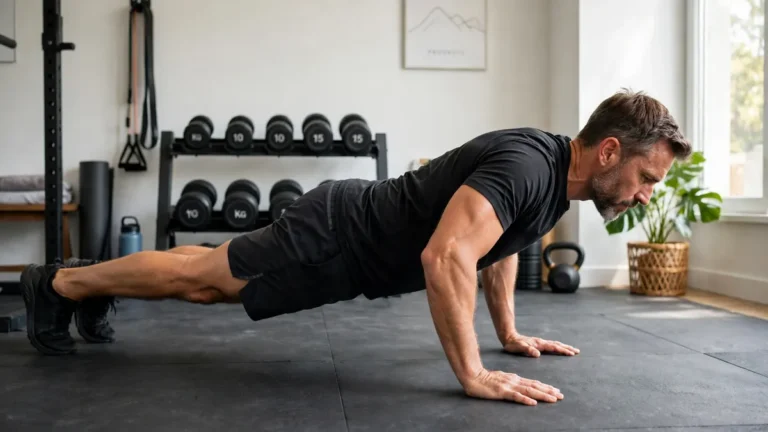
- Push (horizontal): wall push-up → incline push-up → knee push-up → full push-up → decline/diamond/Archer. Chest, shoulders, triceps. (Full ladder in our push-up progression guide.)
- Push (vertical): pike push-up → elevated pike push-up → wall handstand hold → handstand push-up negatives. Shoulders.
- Pull: this is the hard one without equipment — see the section below. Back and biceps.
- Core: dead bug → plank → side plank → hollow body hold → hanging knee raise (if you have a bar). Midline.
Every movement has a ladder from easy to brutally hard — find your current rung and climb one at a time. That’s the entire “secret” of bodyweight programming.
Solving the Pull Problem (No Bar, No Worries)
Push-ups and squats are easy without gear; pulling is the gap. Your back needs pulling work for posture, shoulder health, and balanced development. Options, from best to workable:
- A pull-up bar. Doorway bars cost $40–$80 in Australia and transform a bodyweight program. If you buy one piece of equipment, this is it. Can’t do a pull-up yet? Use a chair for assisted reps, or do negatives (jump up, lower slowly).
- Table rows. Lie under a sturdy dining table, grip the edge, and row your chest to the table. Surprisingly effective — and free.
- Towel rows in a doorway. Loop a towel around a door handle (door closed and latched, towel on your side), lean back, and row. Check the door’s sturdiness first.
- Backpack rows. Fill a backpack with books, hold it, and do bent-over rows. Adjustable weight, zero cost.
- Superman pulls and prone W/Y raises. No equipment at all — they train the upper back and rear delts, though they can’t match real rows for lat development.
Do not skip pulling. The bloke who does 200 push-ups a week and zero rows is building shoulder problems and a hunched posture.
Level 1: Foundation (Weeks 1–4)
Three days a week (Mon/Wed/Fri). 25–30 minutes. Master the basics with perfect form.
- Bodyweight squat — 3×12 (2-second descent, controlled)
- Incline or knee push-up — 3× max clean reps (use your current level from the push-up ladder)
- Glute bridge — 3×15 (2-second squeeze at top)
- Table rows or towel rows — 3×10
- Dead bug — 3×8 per side
- Plank — 3×30 seconds
Rest 60–90 seconds between sets. The goal this month isn’t exhaustion — it’s owning every movement pattern with clean technique. Film your squats and push-ups from the side in week 1 and compare in week 4 — good patterns now prevent injuries later.
Level 2: Building (Weeks 5–12)
Three to four days a week. 30–40 minutes. Now we add intensity through harder variations and density.
Workout A (Mon/Thu):
- Split squat — 3×10 per leg
- Full push-up — 4× max clean reps (stop 2 short of failure)
- Single-leg glute bridge — 3×10 per leg
- Pull-up negatives or table rows — 4×8
- Hollow body hold — 3×20 seconds
Workout B (Tue/Fri):
- Bulgarian split squat — 3×8 per leg (back foot on chair)
- Pike push-up — 3×8–12
- Reverse lunge — 3×10 per leg
- Backpack bent-over row — 3×12
- Side plank — 3×30 seconds per side
Alternate A and B. When you can complete all sets and reps comfortably, move to the next progression on the ladder (e.g. split squat → Bulgarian split squat). This “graduate and climb” system is your progressive overload.
Level 3: Advanced (Month 4+)
For blokes who’ve outgrown Level 2 — this is genuinely challenging training.
- Pistol squat (assisted → full) — 4×5 per leg
- Archer push-up or decline push-up — 4×8 per side
- Nordic curl negatives — 3×5 (knees on cushion, lower slowly, push back up)
- Pull-up — 5× max reps (weighted with backpack when 10+ reps is easy)
- Handstand push-up negatives or elevated pike push-up — 4×6
- Hanging knee/leg raise — 3×10 (needs a bar)
The jump from Level 2 to Level 3 typically takes 3–6 months of consistent work — there’s no rush; Level 2 done well builds an impressive, capable physique on its own.
Progression Methods: How a Bodyweight Workout Plan No Gym Keeps You Gaining
Since you can’t just “add 2.5kg,” use these levers:
- Harder variations. Climb the ladders above. This is the primary driver — a pistol squat loads one leg with your full bodyweight, which exceeds what most gym-goers ever squat per leg.
- More reps. Work from 8 to 15+ reps before progressing variations. Higher reps build endurance and work capacity.
- Slower tempo. 4-second negatives double the time under tension. A set of 8 slow push-ups can humble someone who does 25 fast ones.
- Shorter rests. Compress rest from 90 to 45 to 30 seconds. Same work, greater density, bigger conditioning effect.
- Added weight. A backpack full of books is a legitimate loading tool — 10–20kg transforms push-ups, split squats, and pull-ups. A $80–$150 weight vest is the deluxe version.
- Unilateral work. Single-leg and single-arm variations roughly double the load per limb. This is the bodyweight lifter’s “heavy day.”
Track which lever you’re pulling in your training log — “Bulgarian split squat, 3×10, 60s rest” becomes “3×12” or “3×12, 45s rest”: visible, systematic progress without a single plate.
Sample Week: Putting It Together
Mon: Workout A (30–40 min)
Tue: 30-min walk + 10 min mobility (see our stretching routine)
Wed: Workout B
Thu: rest or easy walk
Fri: Workout A
Sat: longer walk, hike, or sport
Sun: rest
Total training time for this bodyweight workout plan no gym setup: about 2 hours of structured work plus walking. The Australian physical activity guidelines’ recommendation — muscle-strengthening activities on 2 or more days a week, plus 30 minutes or more of moderate- to vigorous-intensity activity on most days — is comfortably cleared by this week. For the full framework, the guidelines live at health.gov.au.
Common Bodyweight Workout Plan No Gym Mistakes
Training to failure every set. Grinding out ugly final reps teaches bad patterns and fries your joints. Stop 1–2 reps short of failure on most sets; save the all-out efforts for monthly tests. Quality reps build strength; ugly reps build injuries.
Speeding through reps. Fast, bouncy push-ups and squats use momentum, not muscle. Control the negative (lowering) phase — 2–3 seconds down — and you’ll get twice the training effect from half the reps. The tempo is the load when there’s no weight.
Skipping pulling. Worth repeating because everyone does it: push-ups without rows creates imbalances that show up as shoulder pain within months. Every push needs a pull. No exceptions.
Never progressing. Doing the same 3×10 knee push-ups for six months is maintenance, not training. If a variation feels easy for two weeks straight, move up the ladder. Comfort is the enemy of adaptation.
Comparing to gym training. Bodyweight progress looks different — it’s measured in harder variations and cleaner reps, not kilos on a bar. A bloke doing strict pistol squats and 15 pull-ups is stronger than most gym-goers, even though he never touches a barbell. Judge the method by its results, not by gym culture’s metrics.
The Hybrid Approach: Bodyweight + One Bell
The ultimate budget setup: this bodyweight program plus a single kettlebell. The kettlebell covers what bodyweight training does worst — heavy hinge loading (swings, deadlifts) and easy progressive leg loading (goblet squats) — while bodyweight covers pressing, pulling, and core. Total cost: $60–$100 for the bell.
A sample hybrid week: Monday — kettlebell session (swings, goblet squats, presses, carries from our kettlebell guide); Wednesday — bodyweight Workout A; Friday — bodyweight Workout B; weekend — a long walk or hike. That’s a complete, progressive, genuinely effective training system for less than the cost of two months at a commercial gym. When you’re ready to expand, our budget home gym guide shows the next steps.
Tracking Progress Without a Gym Log
Bodyweight progress is less obvious than “added 2.5kg to the bar,” so track deliberately. Each session, note: exercise, variation, sets, reps, rest periods, and how hard it felt (1–10). Monthly, retest two benchmarks: max clean push-ups and max strict pull-ups (or rows). These two numbers tell you nearly everything about your upper-body progress.
For legs, track your hardest variation: when Bulgarian split squats at 3×12 become easy, note the date you moved to assisted pistols. Photograph your form quarterly — visible improvements in depth and control are progress even when rep counts stall. And measure what matters to you: waist, weight, how your clothes fit, whether stairs wind you. The scale lies about body composition; the mirror, the tape measure, and your performance tell the truth together. Review your log monthly — patterns emerge (which variations stalled, which progressed fast) that tell you exactly where to focus next.
A bodyweight workout plan no gym needed is the simplest training system most men will ever follow — start at Level 1 this week, climb one rung at a time, and let consistency do the heavy lifting.
FAQs
Can you build muscle with only bodyweight exercises?
Yes — a bodyweight workout plan no gym needed can build muscle, especially in the first 1–2 years. Muscle responds to tension and progression, not iron specifically. Harder variations, slower tempos, and unilateral work provide progressive overload. Legs eventually benefit from added weight, but most men have huge untapped potential in bodyweight progressions.
How long should a bodyweight workout take?
25–40 minutes for the routines in this plan. Bodyweight sessions are naturally dense — minimal setup between exercises. If you’re training longer than 45 minutes, you’re resting too much.
Do I need a pull-up bar for a bodyweight program?
It’s the single most valuable purchase ($40–$80), but not mandatory. Table rows, towel rows, and backpack rows cover pulling adequately until you decide to invest.
How often should I do bodyweight workouts?
Three to four days a week for the full-body routines here, with rest or easy walking days between. Muscles need 48 hours to recover from hard sessions — the same as weight training.
When should I add weights to bodyweight training?
When progressions stall for 4+ weeks despite consistent training, or when you specifically want heavier leg loading. A weighted vest, a heavy kettlebell, or adjustable dumbbells all integrate seamlessly with these routines.